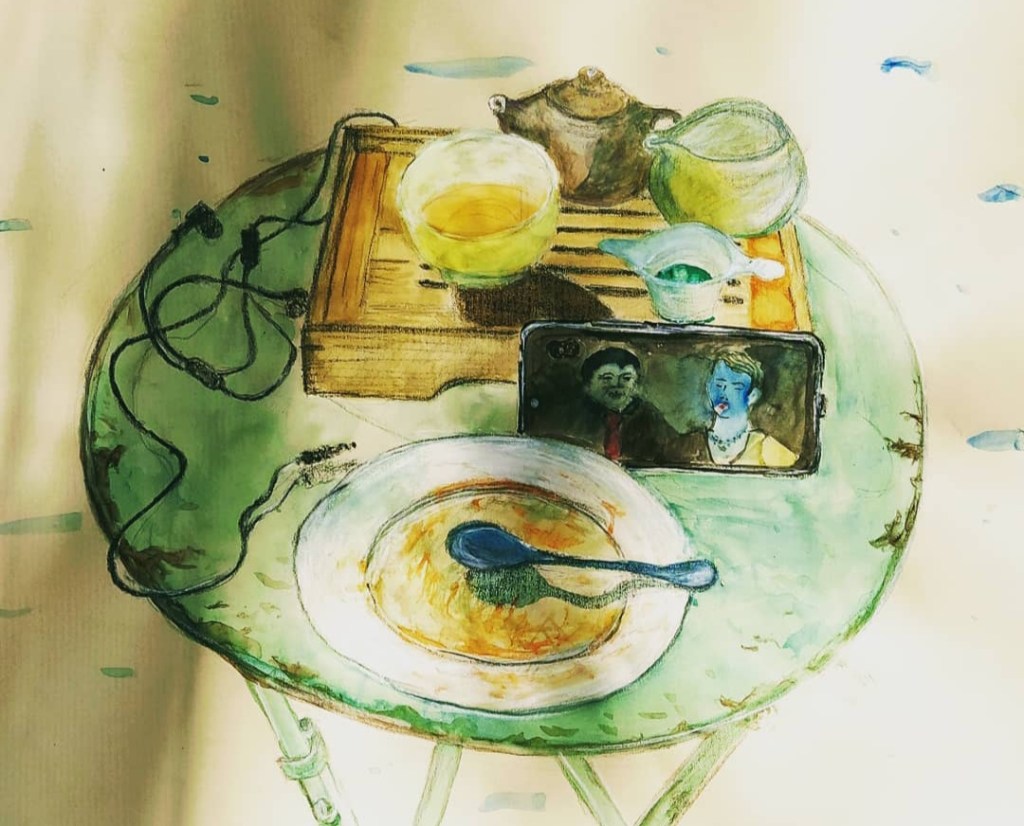

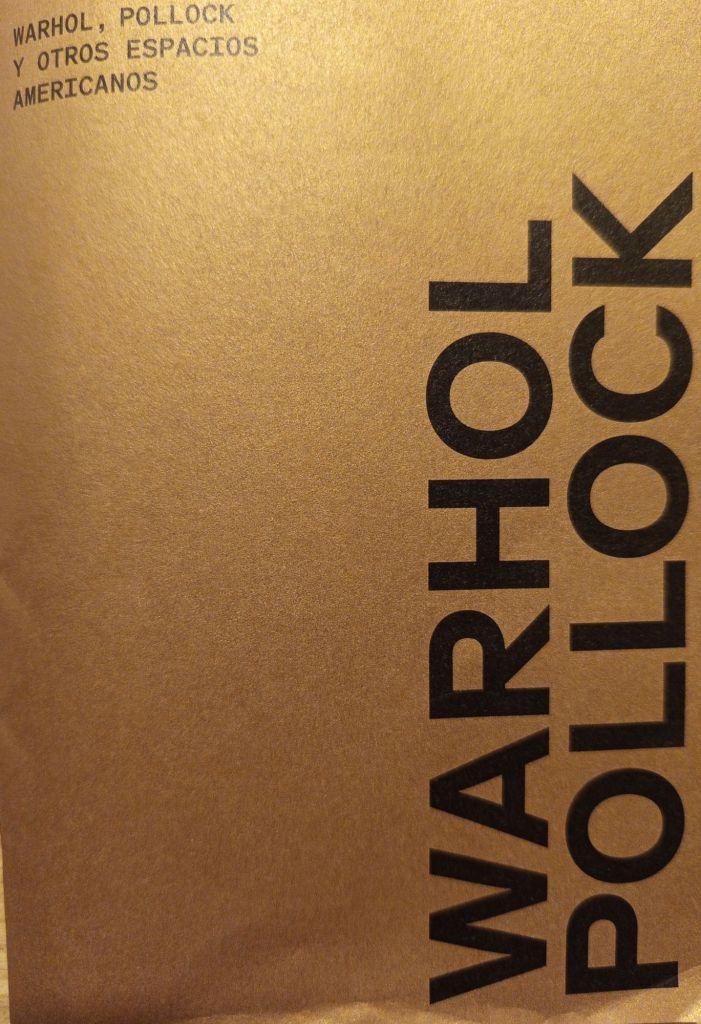
Hoy fui al Museo …
…Thyssen, en Madrid, con ese deseo, tan humano, de mirar lo que otros soñaron. La exposición se llamaba ‘Warhol–Pollock’, y en sus salas se alzaban también Rothko, Sol LeWitt, Cy Twombly, Helen Frankenthaler… Todos ellos, hijos de un mismo vértigo, de una misma fiebre por decir el mundo de otra manera.
Era, como casi siempre en el Thyssen, una exposición bien hecha, segura de sí, con ese aire de elegancia que no necesita anunciarse. Pero —¡ay!— Pollock se me hizo escaso. Lo sentí como un río al que no le permiten desbordarse. Warhol, en cambio, reinaba con su calma fría, con su sonrisa de espejo. No me molestó; simplemente, me dejó en una especie de distancia. Era buena la muestra, sí, pero no toda ella me tocó el corazón.
Me detuve, sin embargo, ante Frankenthaler. ¡Qué modo tan puro de respirar el color! Como si la pintura flotara y se dejara ser. Y luego, Warhol otra vez, con sus oxidaciones, esos metales donde el tiempo pinta, y sus ‘Piss Paintings‘, tan vulgares de nombre y tan nobles de resultado. No los conocía. Me sorprendieron. Me ganaron. Pollock, en su rincón, seguía ardiendo —breve, pero inmenso— como una hoguera que se apaga sin rendirse.
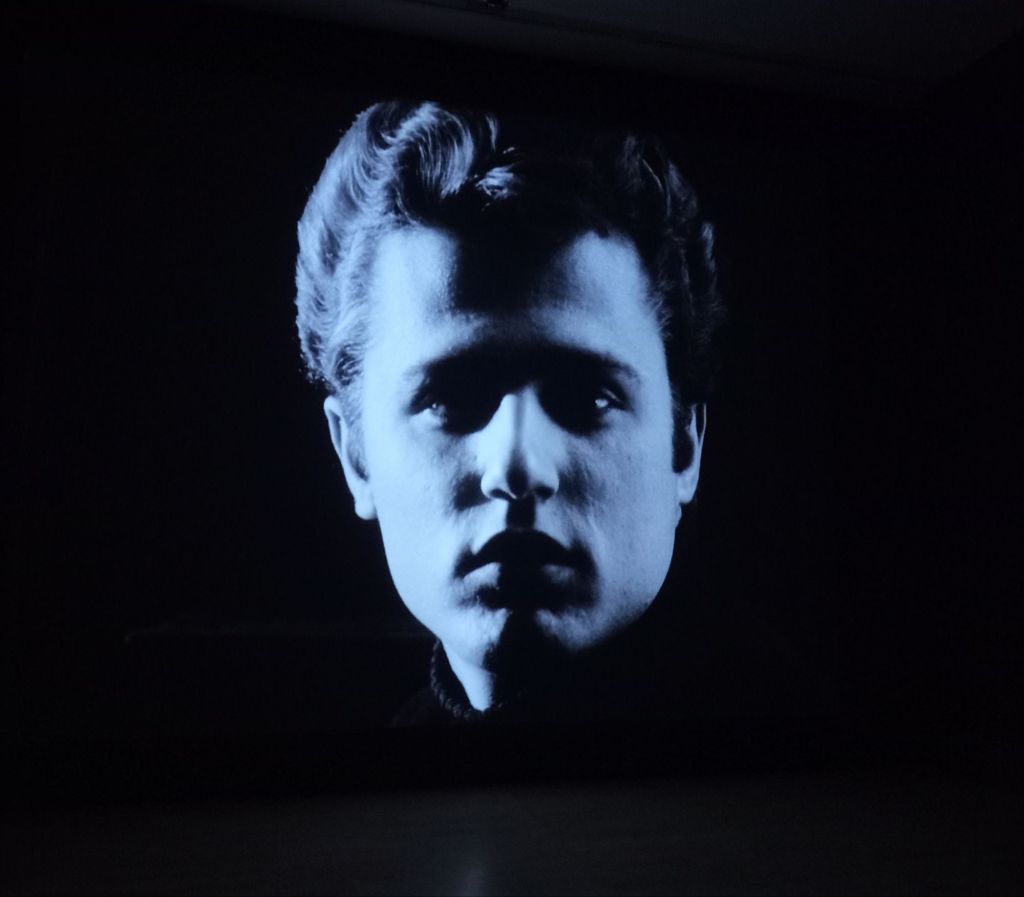
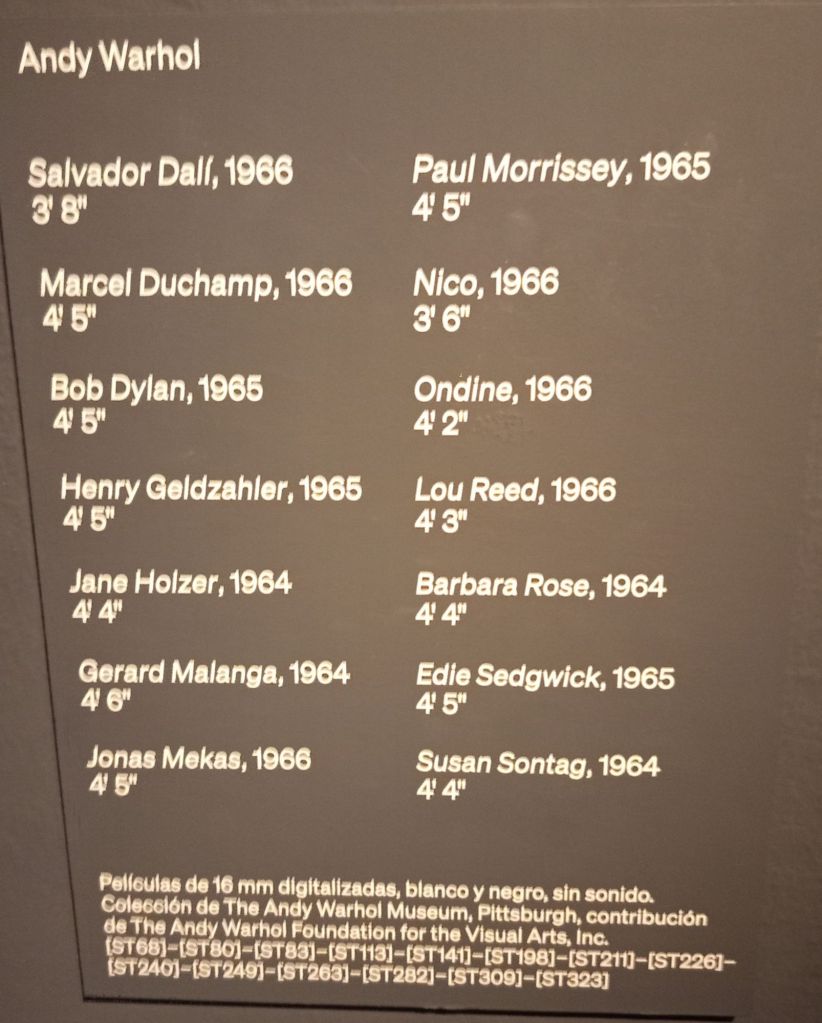
Al final, cómo no, aguardaba la sala de vídeo. Confieso mi prevención: esas sombras proyectadas suelen cansarme. Pero esta vez, algo me detuvo. Era una película de Warhol, un desfile de almas: Bob Dylan, Dalí, Susan Sontag, Lou Reed… Todos callados, quietos, mirados. Cuatro minutos de eternidad cada uno.
La pantalla era grande, y los rostros, casi sagrados. Uno podía perderse en un parpadeo, en un temblor del labio, en esa resistencia tan humana a ser observado. Y de pronto, comprendí: mirarlos era mirarme. Ellos callaban, y mi silencio respondía.
Los demás visitantes pasaban sin ver, impacientes, aburridos. “¿Qué es esto?”, murmuraban, y se iban. Yo me quedé. Aquella quietud me parecía el centro invisible de toda la exposición, el único punto donde el arte no fingía, sino que respiraba.
Claro que también estaban las excursiones, los grupos ruidosos, las risas de las señoras que iban comentando cada cuadro como si el museo fuera una verbena. Me dolió un poco esa falta de recogimiento. El arte —pienso— exige cierta humildad, una forma de silencio. No se grita en una iglesia; tampoco ante un cuadro.
Así, aquella sala de vídeo, que normalmente hubiera evitado, se me reveló como un pequeño milagro. El resto fue desigual, sí, pero ese instante de mirar y ser mirado lo redimía todo. Era el alma de la exposición, escondida al final, esperándonos.
Porque tal vez —me dije al salir— eso sea el arte: un espejo que no miente, una pausa que nos devuelve, por un segundo, a nosotros mismos.
I went down to the Thyssen…
… today, in Madrid. You know, that quiet old palace where art hangs like smoke in the air. They called it ‘Warhol–Pollock’, but it was more than that — Rothko was there, and LeWitt, and Twombly, and Frankenthaler too. All of ’em, those restless American souls who painted not the world, but what trembles inside it.
The show was fine — clean, certain, the kind of thing the Thyssen always does right. But Pollock… man, he barely had a voice in there. Like they’d fenced the river before it could flood. Warhol, though — he was everywhere. Cool as glass, smirking from his silver throne. Didn’t bother me much. I just felt a little outside of it, like a man with his ear to the door of a great party.
Then Frankenthaler — she stopped me cold. Her colors breathing, breaking, turning into air. And Warhol again, with his oxidations, those metallic dreams that time itself painted. And the ‘Piss Paintings’ — hell, I didn’t even know about those. Vulgar in name, but full of grace. They won me over, like a dirty song that still makes you cry.
Pollock was there too — wild, short-lived on the wall. Like lightning flashing once across a long night.
And then, at the end, the video room — the place I usually walk right past. You know the kind: dark corners, humming projectors, pretending to educate people. But this time I stayed. It was a Warhol film — faces of the famous and the nearly forgotten. Bob Dylan (yeah, that guy), Dalí, Susan Sontag, Lou Reed. They just sat there, silent, four minutes each.
The screen was big — bigger than life, bigger than comfort. You could see every breath, every blink. And staring at them, I started seeing myself. Their stillness got under my skin.
Nobody else could stand it. Folks came in, frowned, shuffled off. “What’s this supposed to be?” they muttered. But I stayed. It felt good.
Outside, the tour buses had unloaded a choir of old ladies, laughing, talking, echoing through the galleries like church bells gone wild. And I thought — you don’t shout in a church, do you? Art deserves a kind of silence, a bow of the head, even if just for a heartbeat.
That video room — the one I never wanted — turned out to be the soul of the whole damn thing. The rest was fine, maybe uneven. But that moment, that stare between two worlds, it made the trip worth it.
Maybe that’s what art is after all: a mirror that doesn’t lie, a quiet second when you finally see yourself in somebody else’s eyes.
Tempus perfectum
Wir leben in einer Zeit, in der die Vermessung fast zu einer Hintergrundmusik geworden ist.
Man bemerkt sie gar nicht mehr. Sie läuft einfach mit: die Schritte, die Kalorien, die Konzentrationsphasen, die Schlafzyklen. Ein ständiges Zählen, eine Art Selbstinventar, das so selbstverständlich geworden ist wie früher das Aufziehen einer Armbanduhr.
Und das Faszinierende daran ist: Je genauer diese Instrumente werden, desto diffuser wird das Bild, das wir von uns selbst haben.
Man könnte fast sagen, eine erstaunliche Asymmetrie hat sich aufgetan: Präzision außen, Unschärfe innen. Die Zahlen steigen, die Klarheit sinkt. Es ist, als hätte die Gesellschaft eine Lupe gebaut, die alles vergrößert außer das, worauf es uns eigentlich ankommt.
Diese Diskrepanz zeigt sich in vielen kleinen Alltagsmomenten.
Man weiß vielleicht, wie die Herzfrequenz während eines Spaziergangs verlaufen ist, aber nicht, warum man beim Gehen den Geist nicht frei bekommt. Man kennt die Statistik, aber nicht das Gefühl. Man hat die Daten, aber nicht die Deutung.
Und so entsteht eine merkwürdige Atmosphäre:
Eine Gesellschaft, die sich selbst immer detaillierter erfasst, aber immer weniger versteht.
Wie ein Nebel, der sich schleichend ausbreitet. Ein leiser Zustand der Überbestimmtheit, in dem alles gemessen, aber wenig begriffen wird.
Man könnte sagen, wir entwickeln gerade ein neues Verhältnis zur Wirklichkeit:
Zahlen geben Struktur, aber sie ersetzen keine Orientierung.
Sie beruhigen, ohne zu erklären.
Es ist irritierend.
Ein kulturelles Paradox, das man mit einem gewissen Staunen betrachten kann:
Wir haben die Werkzeuge, die Welt präzise zu erfassen — und gleichzeitig keine gemeinsame Sprache mehr dafür, was diese Präzision eigentlich bedeuten soll.
Wir leben in einer Gesellschaft, die sich selbst vermisst,
ohne genau zu wissen, worauf sie hinauswill.
Eine stille Unvermessenheit im Herzen all unserer Messungen.
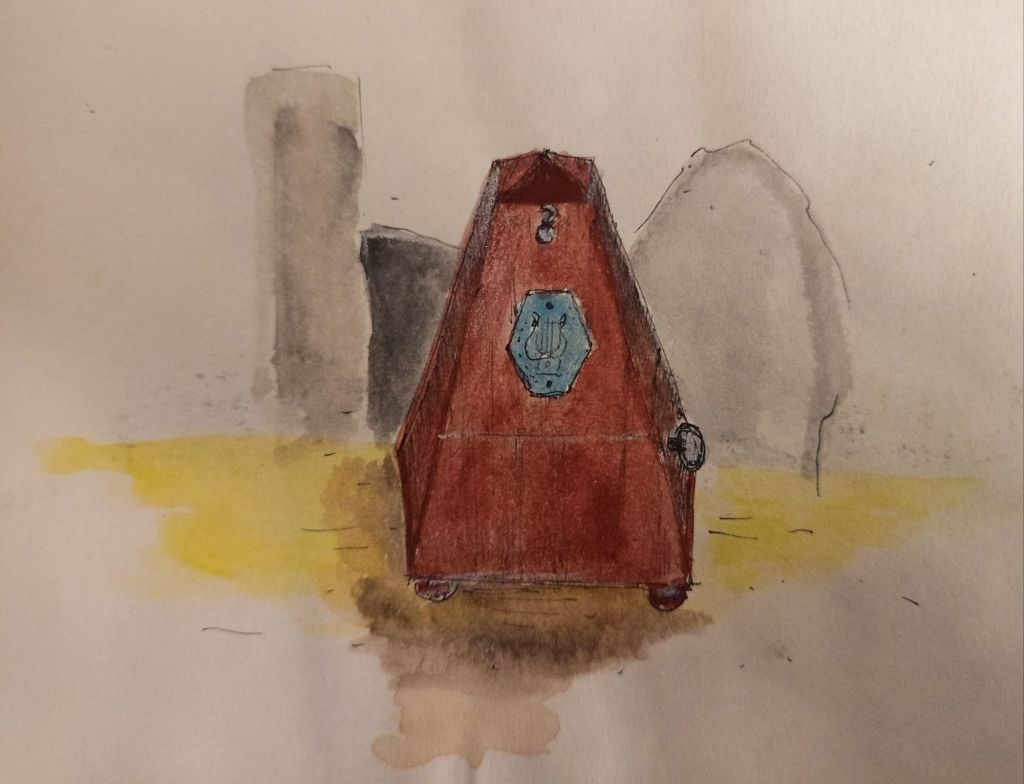
@smihca’25
Tempus perfectum
We live in a time in which measurement has become something like background noise.
You hardly notice it anymore. It simply runs along: the steps, the calories, the focus intervals, the sleep cycles. A constant counting, a kind of self-inventory that has become as natural as winding a watch once was.
What’s fascinating is this: the more precise these instruments become, the more diffuse our sense of ourselves grows.
An odd asymmetry has opened up—precision on the outside, vagueness on the inside. The numbers get sharper, but the understanding grows blurrier. It’s as if society had built a magnifying glass that enlarges everything except the thing we actually want to see.
You can observe this in the smallest moments of daily life.
You may know exactly how your heart rate behaved during a walk, yet have no idea why your thoughts didn’t settle while you were walking. You know the statistics, but not the feeling. You have the data, but not the meaning.
And so a peculiar atmosphere emerges:
a society that captures itself in ever finer detail, while comprehending itself less and less.
A soft haze spreading quietly. A subtle state of over-definition, in which everything is measured but very little is understood.
One could say we are developing a new relationship to reality:
Numbers provide structure, but they don’t provide orientation.
They soothe, but they don’t explain.
It is puzzling.
A cultural paradox you can observe with a certain sense of wonder:
We have the tools to measure the world with precision, yet no shared language for what that precision is supposed to mean.
We live in a society that measures itself
without really knowing what it is measuring toward.
A quiet unmeasuredness at the center of all our measurements.
@smihca’25
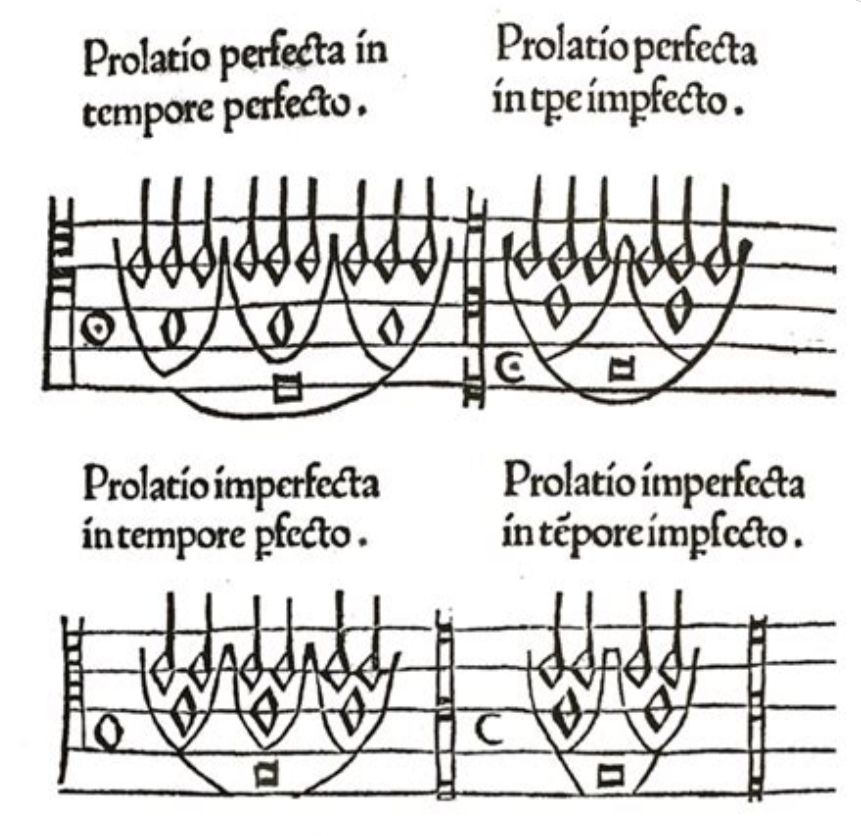
Tempus perfectum
Vivimos en una época en la que la medición se ha convertido en una especie de ruido de fondo.
Uno casi ya no se da cuenta. Simplemente está ahí: los pasos, las calorías, los intervalos de concentración, los ciclos de sueño. Un conteo constante, una especie de inventario de uno mismo que se ha vuelto tan natural como lo era antes dar cuerda a un reloj.
Y lo fascinante es lo siguiente: cuanto más precisos se vuelven estos instrumentos, más difusa se vuelve nuestra percepción de nosotros mismos.
Ha surgido una asimetría curiosa: precisión hacia afuera, vaguedad hacia adentro. Los números ganan nitidez, pero la comprensión se vuelve más borrosa. Es como si la sociedad hubiera construido una lupa que agranda todo, excepto aquello que realmente quisiéramos ver.
Esto se observa en los momentos más pequeños de la vida cotidiana.
Uno puede saber exactamente cómo se comportó el ritmo cardíaco durante un paseo, y sin embargo no entender por qué la mente no logró aclararse mientras caminaba. Se conocen las estadísticas, pero no la sensación. Se tienen los datos, pero no el sentido.
Y así surge una atmósfera peculiar:
una sociedad que se registra a sí misma con un detalle cada vez más fino, mientras se comprende cada vez menos.
Un leve vapor que se expande silenciosamente. Un estado sutil de sobredeterminación, en el que todo se mide pero poco se entiende.
Podría decirse que estamos desarrollando una nueva relación con la realidad:
Los números ofrecen estructura, pero no orientación.
Aportan calma, pero no explicación.
Resulta desconcertante.
Un paradoja cultural que puede contemplarse con cierta extrañeza:
tenemos las herramientas para medir el mundo con precisión,
pero carecemos de un lenguaje compartido para decir qué significa esa precisión.
Vivimos en una sociedad que se mide a sí misma
sin saber realmente hacia qué se está midiendo.
Una silenciosa desmesura en el corazón de todas nuestras mediciones.
@smihca’25
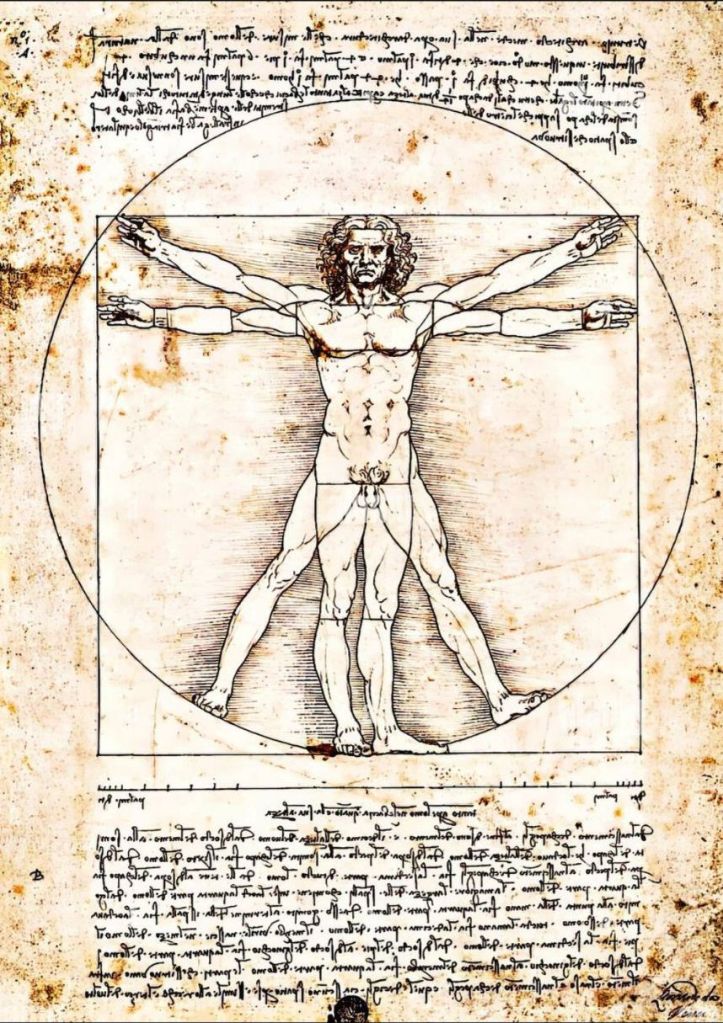

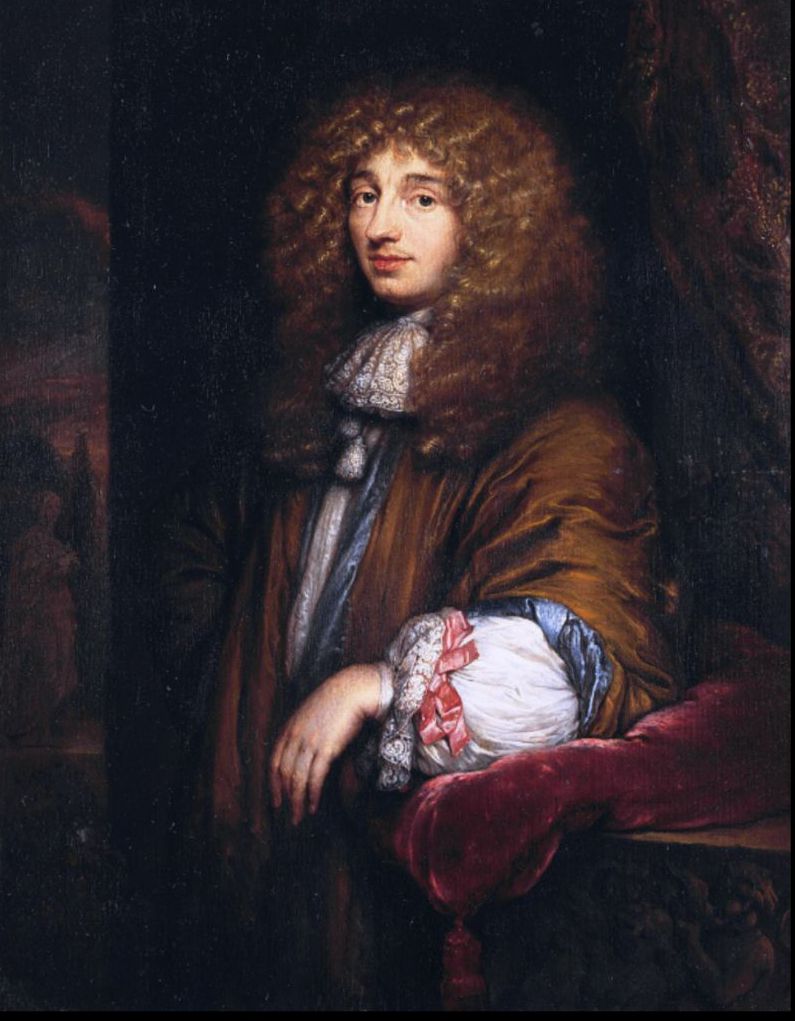
Bandoneon
K’s Vater führte eine kleine Buchhandlung in der Nähe des Bahnhofs.
Er ordnete die Regale selbst, maß die Abstände zwischen ihnen, als könnte Genauigkeit etwas zurückhalten, das sonst zerfallen würde.
Er sagte gern, jedes Buch finde irgendwann seinen Platz.
Er sagte nie, welchen Platz er selbst gefunden hatte.
Man nannte ihn einen Mann von Geschmack, obwohl in seinem Leben kaum etwas nach Wahl aussah.
Früher, so hieß es, habe er Künstler werden wollen – ich weiß nicht, welcher Art.
Dieser Wunsch war früh untergegangen, wie ein Stein in tiefem Wasser.
Als ich ihn kennenlernte, war er bereits derjenige, der inmitten der Stimmen anderer lebte, ordentlich, zurückhaltend, zuverlässig.
In Buenos Aires, auf einer Reise, für die er lange gespart hatte, kaufte er ein Bandoneon.
Er war aus Versehen in ein Musikgeschäft geraten, auf der Suche nach einem Café, und blieb wegen des Geruchs – Leder, Staub und etwas Metallischem.
Der Mann hinter dem Tresen erzählte ihm die Geschichte des Instruments:
dass es in Deutschland für Kirchenmusik gebaut, über das Meer gebracht und schließlich vom Tango verführt worden sei.
K’s Vater nickte, als sei ihm dieser Absturz vom Heiligen ins Weltliche vertraut.
Er kaufte es, ohne nach dem Preis zu fragen.
Am Flughafen hielten sie ihn auf.
Sie baten ihn, den Koffer zu öffnen.
Als sie die Bälge zusammendrückten, kam ein kurzer, rauer Ton heraus – kein richtiger Klang, eher ein Atemzug.
Die Männer lachten.
Er stand da, mit diesem Gesichtsausdruck, den er hatte, wenn er etwas nicht verstand, aber keine Fragen stellen wollte.
Als alles vorbei war, packte er das Instrument wieder ein – sorgfältiger als zuvor.
Zuhause stand das Bandoneon im Regal, zwischen zwei Reihen gebundener Bücher – unbewegt, abgestaubt, perfekt ausgerichtet.
Er erzählte die Geschichte seines Kaufs oft.
Mit der Zeit wurde sie kürzer, bis sie nur noch aus einem Satz bestand:
Einmal, in Buenos Aires, habe ich ein Bandoneon gekauft.
Er sagte es, als erkläre das etwas. Aber es erklärte nichts.
K wurde Musiker.
Er kam nie, um K spielen zu hören.
Einmal, als K übte, hörte er, wie Vater vor der Tür stehen blieb.
K wartete, dass er hereinkam.
Er ging weiter.
Sie sprachen nie darüber.
Nach seinem Tod fand K das Bandoneon am selben Platz.
Es war steif geworden vom Nichtgebrauch.
K versuchte, die Bälge zu öffnen, aber sie gaben nicht nach – als wäre die Luft darin schwer geworden.
K ließ es.
Es gab keinen Grund, Gewalt anzuwenden.
K schloss den Koffer und stellte ihn zurück ins Regal, so wie er es gehalten hatte – verschlossen, bewahrend, mit allem, was nie entweichen konnte.
The Bandoneon
K’s father kept a small bookshop near the station.
He arranged the shelves by hand, measuring the spaces between them as if precision might hold something back from collapse.
He liked to say that every book found its place eventually.
He never said what he thought his own place was.
People called him a man of taste, though nothing in his life seemed chosen by him.
He had once wanted to be an artist — I never knew what kind — but that wish had gone under early, like a stone thrown into deep water.
By the time I got to know him, he was the sort of man who lived tidily among other people’s voices.
In Buenos Aires, on a trip he had saved for years to take, he bought a bandoneon.
He had gone into a shop by mistake, looking for a café, and stayed because of the smell — leather, dust, and something faintly metallic.
The man behind the counter told him the story of the instrument: how it was built in Germany for church music, carried across the ocean, and seduced by the tango.
K’s father nodded, as if the fall from sacred to profane were familiar to him.
He bought it without asking the price.
At the airport they stopped him.
They asked him to open the case.
When they pressed the bellows together, a short, raw sound came out — not quite a note, not quite a breath.
The men laughed.
He stood there, looking at them with the expression he used when he didn’t understand but refused to ask.
When it was over, he packed everything again, more carefully than before.
After that, the bandoneon stood on a shelf between two rows of hardcovers — unmoving, dusted, perfectly centered.
He told the story of buying it many times.
Each telling grew shorter until it became a single line: Once, in Buenos Aires, I bought a bandoneon.
He said it as if it explained something, though it never did.
K became a musician.
He never came to hear K play.
Once, when K was practising at home, he heard him pause outside the door.
He stayed there for a moment, then moved on.
They never mentioned it.
After he died, K found the bandoneon exactly where it had always been.
It resisted when K tried to open it — the leather stiff, the air inside heavy, stale.
K stopped.
There was no reason to force it.
K closed the case and set it back on the shelf, leaving it sealed the way father had kept it, holding in whatever it was that had never managed to escape.
Welt und Atem
Es ist, als habe der Mensch sich aus dem Atem der Welt herausgedreht.
Er steht da, von Dingen umstellt,
die ihn wärmen und doch kälter machen.
Er lebt in einer Klarheit aus Glas,
und alles, was ihn berührt,
hat keine Hand mehr.
Er hat vergessen,
dass der Wind ihn beim Namen rief,
dass jede Welle, jedes Blatt
ihn einst meinte.
Er glaubt, er habe die Welt verlassen,
doch die Welt hat ihn nur still
in sich eingeschlossen.
Denn nichts geht verloren.
Der Staub, den wir aufwirbeln,
kennt den Weg zurück.
Die Luft, die uns nährt,
trägt unsere Müdigkeit davon
und bringt sie heim,
in Kreisläufe, die älter sind als Erinnerung.
Wir nennen es Fortschritt,
doch es ist ein Schlaf.
Wir nennen es Wissen,
doch es ist ein Zittern,
das wir nicht mehr fühlen.
Die Erde aber,
unsere große Mitwisserin,
sie wartet.
Mit jenem leisen Gleichmut,
der alles trägt.
Manchmal spricht sie in Stürmen,
manchmal in Stille.
Und wer hört,
der hört in ihrem Schweigen das eigene Herz.
Vielleicht ist das, was wir Rückkehr nennen,
ein Erwachen,
wo wir nicht mehr unterscheiden
zwischen Welt und Atem.
Denn sie war nie außerhalb von uns.
Sie war in der Haut, im Blick,
im ersten Wort und im letzten.
Sie war das,
was wir suchten,
indem wir uns verloren.
Und wenn eines Tages
unser Herz wieder offen steht,
wird sie hineinströmen —
als Erinnerung.
Dann wird der Mensch nicht gerettet sein.
Nur ganz.
Recognition
I saw Man, bright with circuits and steel,
walking upon the face of the Earth,
forgetting that her breath was his own.
He clothed himself in glass and light,
and said: “I am safe.”
But his safety was the slow forgetting
of the wind that once spoke his name.
He turned the pulse of life into numbers,
the rain into data,
the seed into property.
And in this arithmetic of dominion,
he lost the grammar of wonder.
His machines sang to him in binary hymns;
their light was steady,
their mercy cold.
And he bowed before them,
saying, “This is knowledge.”
The Earth looked upon him —
not in anger,
but in memory.
She whispered through drought,
sighed through flood,
and waited.
Her patience was vast —
the patience of all that still believes in birth.
For she knew: the child who wanders far
must one day hear his mother’s song
through the silence of his own heart.
But the man heard nothing.
He moved through the day as through a mirror,
seeing only his own reflection
and mistaking it for the world.
Yet in the deepest cell of his body,
the old light burned still —
the same that flamed in Eden
and in the first trembling leaf.
It waited —
not to punish,
but to remember.
Not to return to the past,
but to awaken the present.
Then I heard the Earth breathe.
It was not the breath of storm or judgment,
but of union —
a sigh that moved through blood and soil alike.
And the voice said:
“You were never outside of me.
You were the question I asked myself.
And I am the answer
that still waits within you.”
And I knew then —
that salvation is not ascent,
but return.
Not escape,
but recognition.
For to feel the world again
is to remember what the gods forgot:
that the divine and the human
are two names for one breath.
Nicht zwei
1.Variation
Kunst. Natur. Dasselbe.
Die Rose. Ein Konzert. Kein Unterschied. Kein Sieg, kein Verlust. Sie stehen. Sie vergehen.
Eine Stunde Rose. Blicken. Warten. Nichts. Etwas. Dann wieder nichts.
Eine Stunde Konzert. Hören. Warten. Klang. Schweigen. Klang. Dann wieder Schweigen.
Wir wollen Kunst. Wir machen Kunst. Nicht anders als atmen. Nicht anders als wachsen. So wie die Rose wächst. So wie der Stein liegt.
Natur sein. Kunst sein. Dasselbe.
Alter? Nichts in der Kunst. Sie spricht, gleichgültig. Ob jung. Ob alt. Nur Stimme. Nur Hand. Nur Spur.
Und die Dämonen. Immer da. Doch manchmal lassen sie los. Durch Klang. Durch Blüte. Durch nichts.
smihca’25
Not Two
Variation 1
Art. Nature. The same.
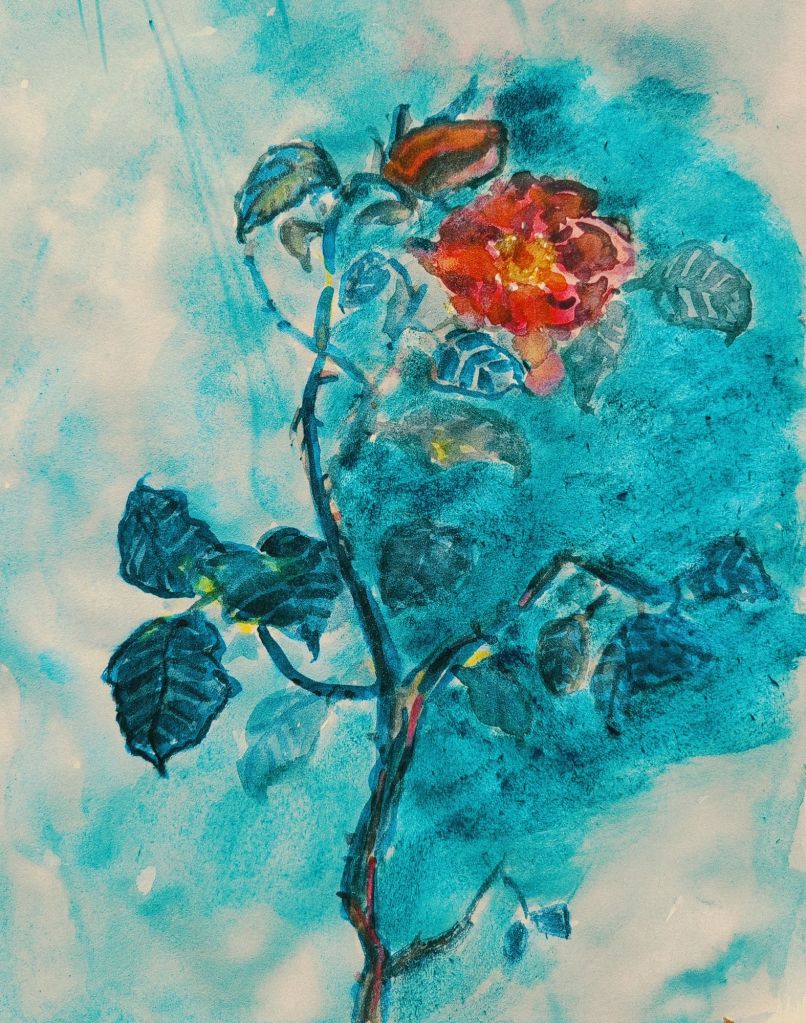
The rose. A concert. No difference. No victory, no loss. They stand. They pass.
An hour of rose. Looking. Waiting. Nothing. Something. Then nothing again.
An hour of concert. Listening. Waiting. Sound. Silence. Sound. Then silence again.
We want art. We make art. No different from breathing. No different from growing.
As the rose grows. As the stone lies.
To be nature. To be art. The same.
Age? Nothing in art. It speaks, indifferent. Whether young. Whether old.
Only voice. Only hand. Only trace.
And the demons. Always there.
Yet sometimes they let go.
Through sound. Through blossom. Through nothing
smihca’25
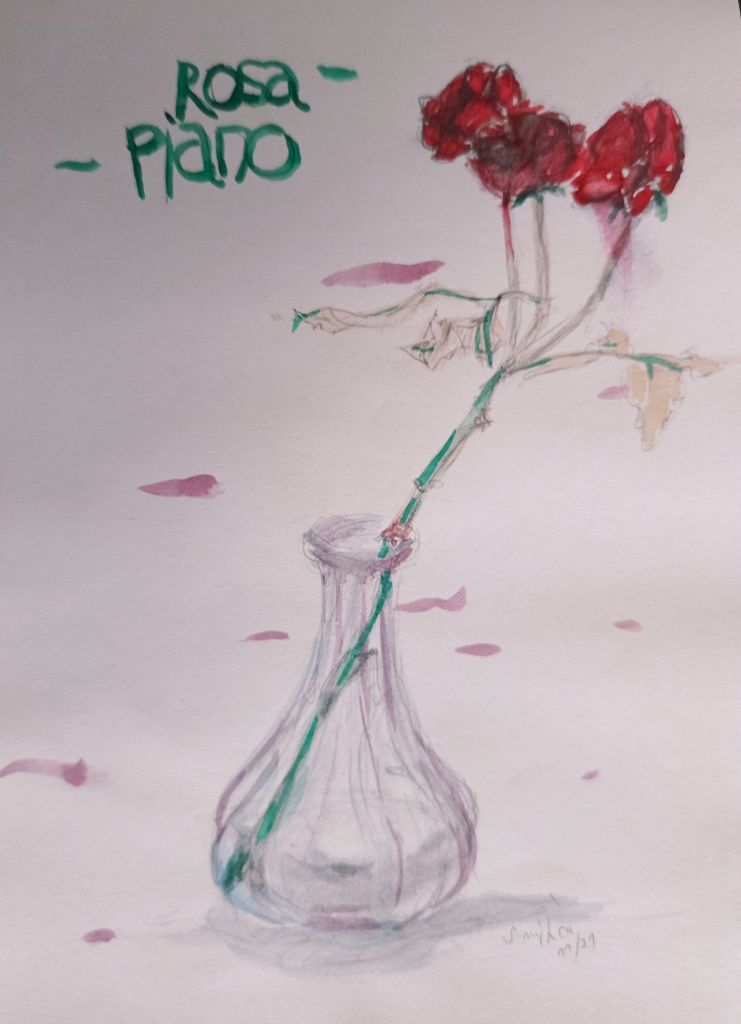
Not Two
Variation 2
Voice: Rose.
Echo: Breath.
Chorus: We bloom — we wither.
Voice: Concert.
Echo: Time.
Chorus: We sound — we vanish.
Voice: Rose and Concert.
Echo: Not two. Not one.
Chorus: A circle — without border.
Voice: An hour with the Rose.
Echo: Stillness.
Chorus: We gaze back.
Voice: An hour with Sound.
Echo: Flow.
Chorus: We hear ourselves.
Voice: Stones.
Echo: Silence.
Chorus: We rest since the beginning.
Voice: Animals.
Echo: Silence.
Chorus: We breathe you in the dark.
Voice: We.
Echo: Silence.
Chorus: You are our silence.
Voice: Silence?
Echo: Song.
Chorus: And Song is Silence.
Voice: Age.
Echo: No age.
Chorus: We do not count.
Voice: Muse.
Echo: No face.
Chorus: Only voice in the air.
Voice: Demons.
Echo: Shadows.
Chorus: We remain.
Voice: Rose.
Echo: Shadow.
Chorus: We scent the night.
Voice: Sound.
Echo: Shadow.
Chorus: We echo in the stone.
Voice: We.
Echo: Shadow.
Chorus: You are our shadow.
Voice: Shadow upon shadow.
Echo: Light.
Chorus: And Light is Shadow.
Voice: Art.
Echo: Nature.
Chorus: Nature is Art.
Voice: Beginning?
Echo: No beginning.
Chorus: End? No end.
All together: Only Circle.
smihca’25
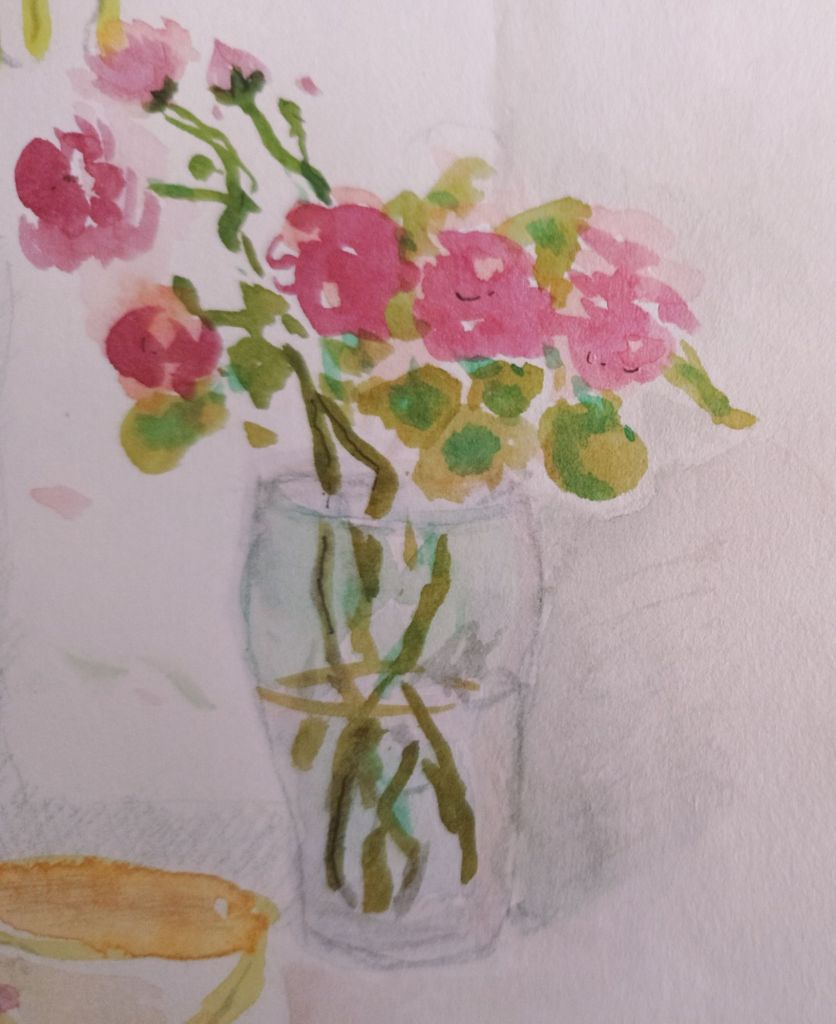
Nicht Zwei
2.Variation
Stimme: Rose.
Echo: Atem.
Chor: Wir blühen — wir welken.
Stimme: Konzert.
Echo: Zeit.
Chor: Wir klingen — wir vergehen.
Stimme: Rose und Konzert.
Echo: Nicht zwei. Nicht eins.
Chor: Ein Kreis — ohne Grenze.
Stimme: Eine Stunde mit der Rose.
Echo: Stille.
Chor: Wir blicken zurück.
Stimme: Eine Stunde mit Klang.
Echo: Fluss.
Chor: Wir hören uns selbst.
Stimme: Steine.
Echo: Schweigen.
Chor: Wir ruhen seit dem Anfang.
Stimme: Tiere.
Echo: Schweigen.
Chor: Wir atmen euch in der Dunkelheit.
Stimme: Wir.
Echo: Schweigen.
Chor: Ihr seid unser Schweigen.
Stimme: Schweigen?
Echo: Lied.
Chor: Und Lied ist Schweigen.
Stimme: Alter.
Echo: Kein Alter.
Chor: Wir zählen nicht.
Stimme: Muse.
Echo: Kein Gesicht.
Chor: Nur Stimme in der Luft.
Stimme: Dämonen.
Echo: Schatten.
Chor: Wir bleiben.
Stimme: Rose.
Echo: Schatten.
Chor: Wir duften die Nacht.
Stimme: Klang.
Echo: Schatten.
Chor: Wir hallen im Stein.
Stimme: Wir.
Echo: Schatten.
Chor: Ihr seid unser Schatten.
Stimme: Schatten auf Schatten.
Echo: Licht.
Chor: Und Licht ist Schatten.
Stimme: Kunst.
Echo: Natur.
Chor: Natur ist Kunst.
Stimme: Anfang?
Echo: Kein Anfang.
Chor: Ende? Kein Ende.
Alle zusammen: Nur Kreis.
smihca’25
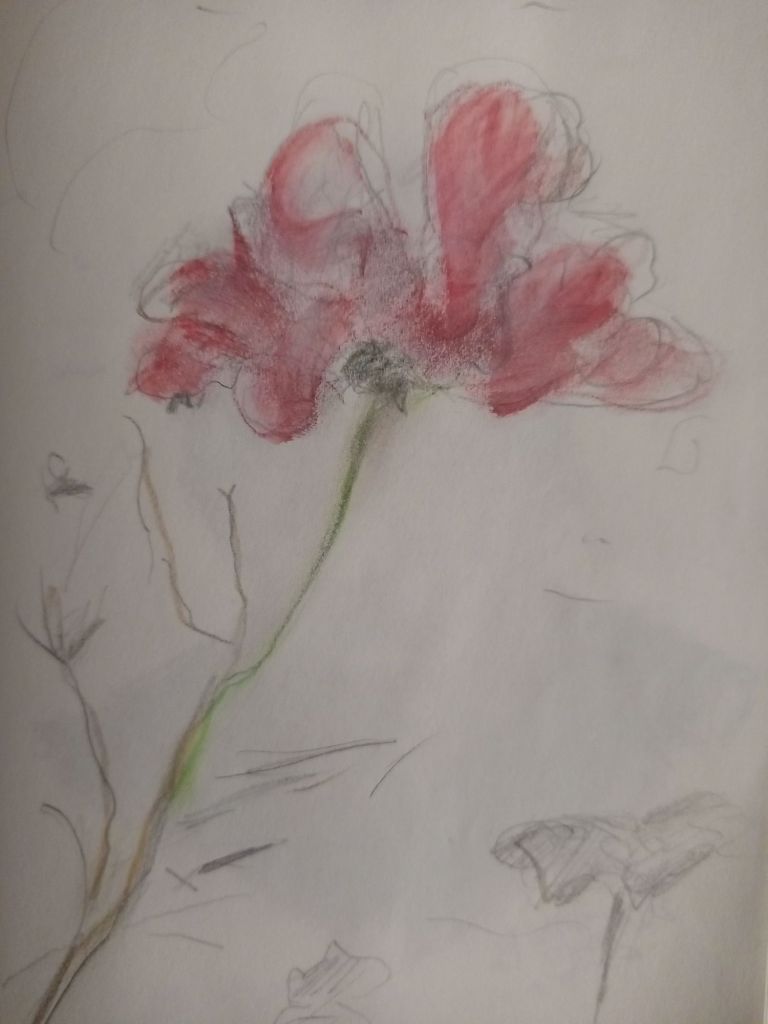
Regreso
I. El Hombre que Huyó de la Naturaleza
Hace siglos que el hombre camina lejos de su origen.
Huye de la naturaleza — y por eso, huye de sí mismo.
A esa huida la llama progreso.
Ha aprendido a encerrarse: contra el viento, contra el azar,
contra la simple evidencia de estar vivo.
Construyó muros, ciudades, refugios de cristal.
Y dentro de ellos, el silencio se volvió costumbre.
Cuanto más protegido, menos siente.
El hombre es esa parte de la naturaleza que se negó a ser natural.
En eso consiste su gloria,
y su pérdida.
II. La Respuesta de la Tierra
La Tierra no calla.
Respira, recuerda, responde.
No habla con palabras, sino con fenómenos:
el fuego, la sequía, la marea, el temblor.
Su idioma es el equilibrio.
Sus gritos son ajustes.
Lo que llamamos desastre
es a menudo una carta de la Tierra:
una forma suya de recordarnos que existimos dentro de ella,
no sobre ella.
No hay castigo,
hay diálogo.
Y a veces la voz que responde
es tan fuerte que nos asusta o nos despierta.
III. El Arte de Protegerse
El hombre moderno se ha convertido en su propio abrigo.
Ha perfeccionado la distancia:
entre su piel y el mundo,
entre su corazón y el temblor.
Cree vivir cómodo,
pero habita en el exilio.
Sus máquinas lo cuidan, lo acompañan,
lo separan.
Ellas prolongan la vida,
pero le roban la sensación de estar vivo.
Son los nuevos dioses — silenciosos, luminosos,
y tan fríos como la inmortalidad que prometen.
IV. El Cuerpo: Último Jardín de lo Natural
Aun así, en lo más íntimo de ese refugio queda un testigo:
el cuerpo.
Esa memoria de carne que recuerda lo que somos.
En él, la tierra se hace aliento,
y el aliento se convierte en pensamiento.
Todo lo que tocamos nos toca.
Todo lo que arrojamos vuelve a nosotros
en otra forma, en otro tiempo.
La naturaleza vive dentro, no fuera.
El cuerpo lo sabe.
El cuerpo es el eco más antiguo de la Tierra.
V. La Sabiduría del Equilibrio
La salud no es una victoria,
sino un acuerdo.
Un pacto entre la piel y el universo.
El hombre moderno lo ha roto,
y ahora confunde equilibrio con control.
Mide, administra, corrige.
Y en cada intento de dominio
crea una nueva herida.
Quizás el futuro del ser humano
no dependa de su fuerza,
sino de su escucha.
No de la conquista del espacio,
sino del reencuentro con la cercanía:
la del planeta,
la del cuerpo,
la de su propio latido.
VI. Epílogo: El Regreso del Aliento
La Tierra no olvida.
Habla con el viento, con el silencio,
con la paciencia del agua.
No es madre ni enemiga:
es el espejo en que respiramos.
Pensar —tal vez— comience
cuando dejamos de corregirla.
Y la verdadera inteligencia
cuando aprendemos de nuevo a oírla.
El hombre no sana separándose del mundo.
Sana cuando, por un instante,
vuelve a reconocerse en él.
No como dueño,
sino como huésped.

The Wood
He stood before the forest, only it wasn’t a forest.
The paper had swallowed it — green ink and dreamleaf,
a flat Eden pressed and hung, neat as wallpaper.
The screen too — oh, the bright mimicry of it,
leaves without wind, trunks without smell,
the soundless forest of the modern mind.
Still, something in him stirred —
some old pulse, sap moving under thought.
You can’t see a tree and not feel the root of yourself, he thought.
The real wood waits, breathing under the breath of the world.
It knows you before you know it.
Step once, and it’s there — underfoot and within.
Not foreign, no, never foreign;
for in the hush of it all, you belong before you begin.
No entry, no discovery — only return.
And music — the same truth hums there.
The discs and the data, they shine their clean, bloodless light,
perfect, sealed, untouched.
But the living sound — trembling, human, unkept —
that is the one that breathes.
A body giving air to air.
A hand striking strings that shiver into being,
and through them the whole world shakes awake.
A concert — yes — the living act of it,
air meeting ear, moment meeting moment.
You feel it, not as something happening,
but as something that has always been.
The music remembers you as you remember it.
Not invention, not creation — recognition.
So he thought:
Better the rough breath of the forest than the flat image of it.
Better the erring note than the perfect silence.
Better the raw present than the framed forever.
Between what breathes and what only seems to breathe
there’s a hush so deep it almost sings.
And in that hush, if you are still enough,
you might hear yourself —
the quiet truth of what you are,
already whole,
as nature shaped you,
as the living world remembers you to be.
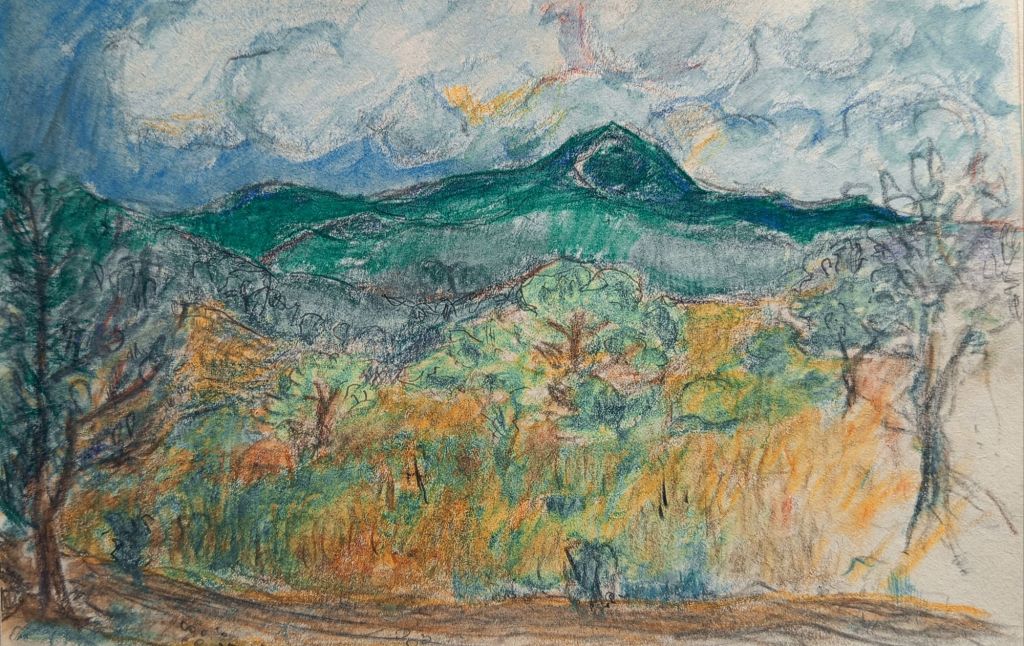
Waldeinsamkeit
Man kann sich vor einen Wald stellen, der keiner ist.
Er hängt an der Wand, ein grünes Muster.
Er flimmert auf dem Bildschirm, immer gleich.
Die Bäume stehen still, das Licht gehorcht.
Kein Wind, kein Schatten, kein Laut.
Ein Wald ohne Atem, ohne Gedächtnis.
Der Mensch liebt solche Abbilder.
Sie gehorchen ihm, sie warten auf ihn, sie stören ihn nicht.
Er kann sie verlassen, wann er will.
Aber der wirkliche Wald verlässt ihn nicht.
Wer ihn betritt, tritt in etwas ein, das ihn schon kennt.
Dort ist niemand fremd.
Der Boden erkennt den Fuß, die Luft nimmt ihn auf,
das Blatt bewegt sich, weil er da ist.
Alles antwortet, ohne zu sprechen.
Die Bäume vergessen nichts.
So ist es auch mit der Musik.
Eine Aufnahme ist sauber, vollkommen, abgeschlossen.
Kein Fehler, kein Zittern, kein Wagnis.
Sie ist ein Bild des Klangs, aber kein Klang.
Man hört, ohne gehört zu werden.
Nichts geschieht mehr.
Im Konzert aber geschieht alles.
Der Ton sucht seinen Raum, der Musiker seinen Atem.
Jede Note kann fallen oder sich retten.
Der Körper ist dabei.
Der Klang weiß, dass wir da sind.
Er wagt sich über uns hinweg, er kehrt zurück.
Er lebt.
Darum: geht in den Wald, geht ins Konzert.
Nicht, weil es schöner ist – weil es wirklich ist.
Dort gibt es kein Bild, keine Wiederholung, kein Besitz.
Nur Gegenwart, nur Antwort.
Der Unterschied zwischen dem, was lebt,
und dem, was bloß erscheint,
ist so groß wie der zwischen Stille und Lärm.
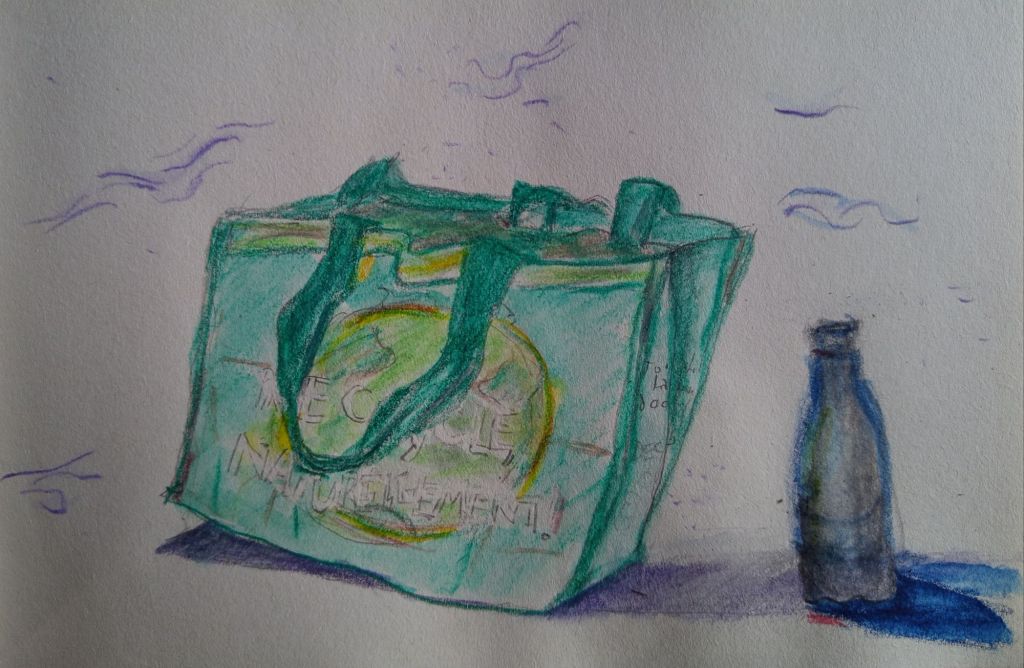
RECYCLÉ NATURELLEMENT
Trained first.
Sweat. Breath.
Nothing proved.
Then the shop.
Pears, apples
The bag — green, waiting.
The bottle — still cool.
I cared.
Enough.
Not to save.
Just to stay.
For me,
for it.
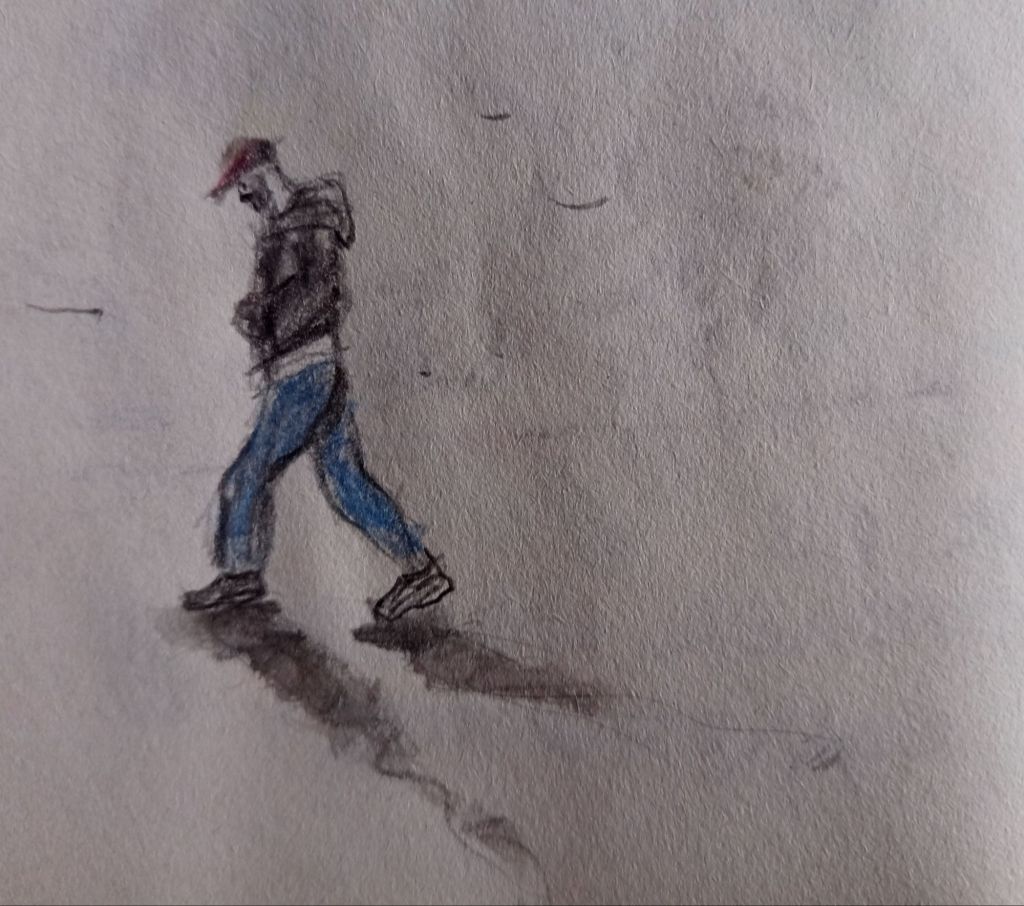
Si perde
Cammina. / He walks. / Er geht
la polvere si alza dust lifts Staub hebt sich
ricade falls fällt
la terra the ground der Boden resta remains bleibt
il tempo time Zeit passa goes vergeht
ogni passo each step jeder Schritt si perde loses itself
verliert sich
 from heart to heart