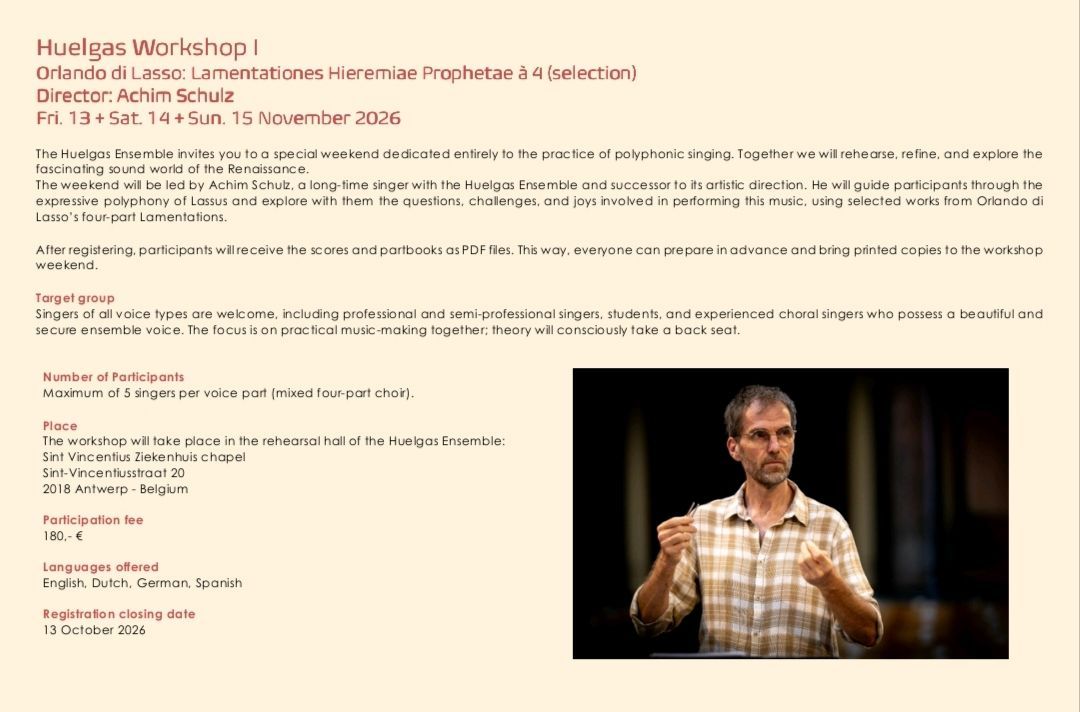
Professional vocalists and/or seasoned ensemble singers with solid vocal skills and excellent tuning. Singers eager to craft lines with flexible phrasing, sensibility, and genuine vocal warmth.
A Special Note for Tenors As the universal law of renaissance music demands: we need tenors.
Lassus wrote lines of incredible harmonic color, rhythmic drive, and vocal nuance for the inner parts—yet nature seems to supply tenors in far more modest quantities. If you are a tenor who enjoys being the expressive backbone of sixteenth-century counterpoint, consider this a direct and enthusiastic invitation.
No representation will take place at the end of our work. It is the sheer pleasure of exploring together without any need of staging.
Everything is stamped with the insignia of the Next, the Immediate, the Right Now.
We live in a present so evacuated that even pauses have been converted into corridors—transitional spaces hustling us toward the subsequent task.
Out of this airless immediacy arise those fine, nearly imperceptible tremors of the nerves which, before long, condense into a general restlessness.
Acceleration is a symptom of a deficit of being.
With it comes the erosion of the contemplative faculty, that capacity which does not produce, does not optimize, does not act in order to achieve, but abides.
Every form is slow. Every form is a detour (Umweg).
The melody itself is a detour—it does not arrive by the shortest distance but by groping, wandering, returning.
The sheet of music lies there within this detour-ness, quiet, patient, inhabiting a peculiar peacetime. It promises duration and persistence, not as grandiloquence but as material fact.
Paper ages. It crackles. It yellows. It bears traces. It is a thing.
The sheet music possesses an aura of friendliness. You take hold of it, and it holds you back—not in reaction, but in resistance. It resists mere disposal. In the tactile pleasure of touching it, a distinct fatigue awakens: not the exhaustion of depletion, not the weary self-disgust of overextension, but a composure that inspires. That disarms. That founds community because it establishes a particular tempo—a consonance, a nearness.
Between its pages lie intervals of time. You turn a page, and the turning is already part of the music. A quiet detour, distant and intimate at once.
So beautifully impractical.
The paper permits the “not-for.” It is there without mandate of purpose. It need not update itself. It wants nothing from me. It rests. And in resting, it forms. Beauty.
The iPad, by contrast, is distance-less. Its smooth surface knows no resistance, only the swipe.
In every swipe lies the possibility of dispersion: the next page of the score—or the invoice from an online purchase. Everything equally near, equally available, equally urgent.
This absence of distance does not create intimacy but a rigid separation.
I before the display.
I and my function.
I in the compulsion to produce.
Practicality instead Beauty of being (Sein).
Here reigns the “in-order-to.”
Every gesture is instrumental. Every click serves.
The economy of efficiency and acceleration causes the long and lingering forms to disappear.
There are no intervals anymore, only transitions. No peacetime, but perpetual activation.
Hyper-attention leaps, brief and rapid, from measure to measure, from window to window, reproducing its own exhaustion.
The sheet music, on the other hand, belongs to another order—one of contemplative life (Cicero).
It allows a clear-eyed tiredness (Peter Handke) that grants access to those longforms which elude the hysteria of the modern society of activity.
It gives shape precisely because it does not optimize.
It is sensuous precisely because it is not “smart,” not calculating.
Its thingness founds a world.
It tells (erzählt) —where the digital device (Rechner) merely counts (zählt).
Perhaps it is precisely its impracticality that saves it.
Paper knows the detour. And only in the detour does duration arise. And only in duration does music come into being.
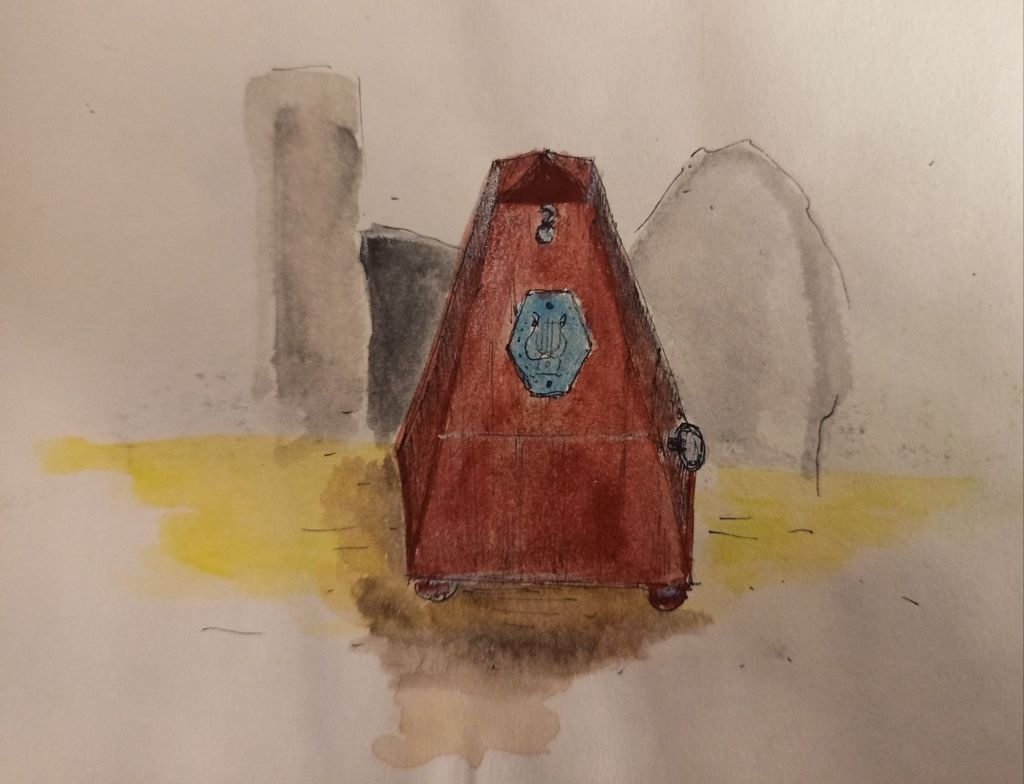
J.N.Mälzel (1772-1838): burocracia de la musicalidad
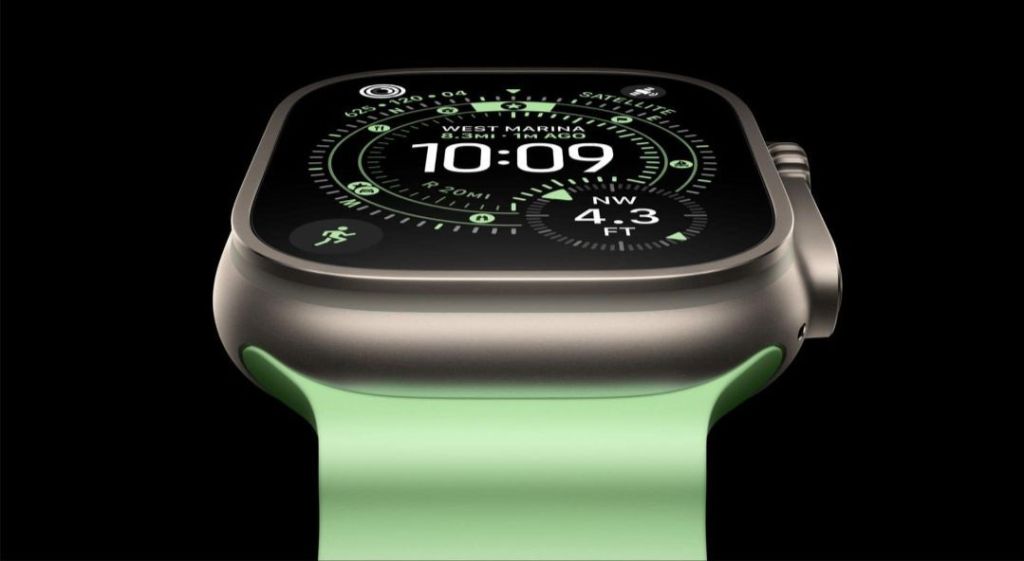
Vivimos en una época en la que la medición se ha convertido en una especie de ruido de fondo. Uno casi ya no se da cuenta. Simplemente está ahí: los pasos, las calorías, los intervalos de concentración, los ciclos de sueño. Un conteo constante, una especie de inventario de uno mismo que se ha vuelto tan natural como lo era antes dar cuerda a un reloj.
Y lo fascinante es lo siguiente: cuanto más precisos se vuelven estos instrumentos, más difusa se vuelve nuestra percepción de nosotros mismos. Ha surgido una asimetría curiosa: precisión hacia afuera, vaguedad hacia adentro. Los números ganan nitidez, pero la comprensión se vuelve más borrosa. Es como si la sociedad hubiera construido una lupa que agranda todo, excepto aquello que realmente quisiéramos ver.
Esto se observa en los momentos más pequeños de la vida cotidiana. Uno puede saber exactamente cómo se comportó el ritmo cardíaco durante un paseo, y sin embargo no entender por qué la mente no logró aclararse mientras caminaba. Se conocen las estadísticas, pero no la sensación. Se tienen los datos, pero no el sentido.
Y así surge una atmósfera peculiar: una sociedad que se registra a sí misma con un detalle cada vez más fino, mientras se comprende cada vez menos. Un leve vapor que se expande silenciosamente. Un estado sutil de sobredeterminación, en el que todo se mide pero poco se entiende.
Podría decirse que estamos desarrollando una nueva relación con la realidad: Los números ofrecen estructura, pero no orientación. Aportan calma, pero no explicación.
Resulta desconcertante. Un paradoja cultural que puede contemplarse con cierta extrañeza: tenemos las herramientas para medir el mundo con precisión, pero carecemos de un lenguaje compartido para decir qué significa esa precisión.
Vivimos en una sociedad que se mide a sí misma sin saber realmente hacia qué se está midiendo.
Una silenciosa desmesura en el corazón de todas nuestras mediciones.
@smihca’25
«Lleno de méritos, pero poéticamente, habita el hombre en esta tierra.
Por eso, mientras la cordialidad, la pura, permanezca en el corazón, el hombre sigue siendo una medida.
¿Existe en la tierra una medida? No, no existe.«
(„In lieblicher Bläue“ Friedrich Hölderlin 1770-1842)